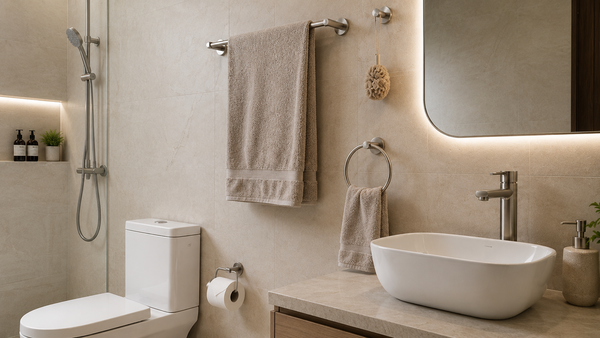
You've probably seen "WC" on a bathroom door, a floor plan or a product label and wondered what it really means. It looks technical, but the answer is plain: WC is short for water closet, and in everyday use a WC toilet is just the toilet itself.
This guide is for Malaysian homeowners and renovators who want a straight answer. We'll cover what the term means, the main WC types you'll find in local showrooms, how much water and money each one uses, and a simple way to pick the right one for your home.
The short video below is a quick primer on why your toilet choice deserves a little thought before you buy.
Toilet Buying Guide: Choose From Different Types of Toilets
Source video: The Home Depot on YouTube
1What does "WC" actually mean?
Quick Answer: WC stands for "water closet" — an old, polite term for a small room with a flushing toilet. Today a WC toilet just means the toilet fixture itself: the bowl and cistern that flush waste away with water. A WC and a toilet are the same thing.
The phrase started in Victorian Britain, when indoor flush toilets were new and a "water closet" was a small private room built just for the toilet. The name stuck and travelled the world. In Malaysia you'll see "WC" most often on floor plans, in property listings and across bathroom sanitary ware listings.
The terms around it overlap, so here's the simple split:
- WC / water closet. The toilet itself, or a small room with only a toilet.
- Bathroom. A full room with a toilet plus a basin, and often a shower or bath.
- Restroom / washroom. A public toilet, common in malls and offices.
One quick note to avoid confusion: in a project schedule, "w/c" can mean "week commencing". But in any bathroom or building context, WC means the toilet. So a "WC set" on a product page is simply a complete toilet — bowl, cistern, seat and lid.
2The main types of WC toilet in Malaysian homes
Quick Answer: Malaysian homes mostly use five WC types: close-coupled, one-piece, wall-hung, back-to-wall and the squat pan. They flush the same way but differ in footprint, price and how easy they are to clean and install. Close-coupled is the everyday default; wall-hung is the space-saving, modern pick

There are five WC styles you'll meet in a local showroom, and the differences are more than cosmetic:
- Close-coupled. The cistern bolts straight onto the bowl as one unit — the most common, affordable and easiest to install. Browse close-coupled WC sets if value is the priority.
- One-piece. Bowl and cistern are moulded as a single smooth shape that wipes clean in seconds. See the one-piece WC range.
- Wall-hung. The bowl floats on a frame with the cistern hidden in the wall. The neatest look and the easiest floor to mop, but it needs a concealed frame and a pro install.
- Back-to-wall. The bowl sits flush to the wall with the cistern concealed in a unit. Tidy and mid-range.
- Squat pan. A floor-level pan, still common in older homes and outdoor toilets.
The honest trade-off is money versus space. A close-coupled set keeps costs down; a wall-hung buys you floor space and a cleaner look for a higher upfront spend. Compare styles across our full WC collections.
| WC type | Floor space | Cleaning | Install | From (illustrative) |
|---|---|---|---|---|
| Close-coupled | Moderate | Moderate | Easy, DIY-friendly | ~RM 300 |
| One-piece | Moderate | Easy | Heavier; one unit | ~RM 600 |
| Wall-hung | Low (floats) | Easiest | In-wall frame; pro fit | ~RM 900 |
| Back-to-wall | Low–moderate | Easy | Moderate | ~RM 600 |
| Squat pan | Low | Hard | Simple floor fix | ~RM 80 |
Illustrative footprint and entry pricing; actual specs and prices vary by model.
Planning a bathroom upgrade soon?
See the full range of WC toilets and sanitary ware before you commit. Browse Big Bath WC options →
3How a WC works: the key parts
Quick Answer: Every WC toilet has four core parts: the pan (the ceramic bowl), the cistern (the water tank), the trap (the curved pipe that holds a water seal against smells) and the flush system (the button or lever). Knowing these names makes buying and small repairs far easier.
When you press the flush, water rushes from the cistern into the pan, pushes waste through the trap, and the trap refills to block sewer gas. That water seal is the reason a toilet doesn't smell. Here are the parts in plain terms:
- Pan / bowl. The ceramic part you sit on, made from vitreous china.
- Cistern. The tank that stores and releases the flush water.
- Trap. The hidden S- or P-shaped bend that holds the water seal.
- Flush mechanism. A single button, dual button or lever.
If a part wears out, knowing these names saves a lot of guesswork. Big Bath stocks water closet spare parts like fill valves, flush valves and soft-close seat kits for quick fixes.
4Flush systems and water use: dual-flush vs single-flush
Quick Answer: Most modern WC toilets in Malaysia use a washdown flush with a dual-flush button — a small flush for liquids, a full flush for solids. Switching from an old single-flush to an efficient dual-flush WC can roughly halve the water your toilet uses, which adds up over a year.
You may see two flush terms. A washdown WC pushes waste out with the flush water — common and cheap to maintain. A washout design holds water in a shelf first — older and less common today. The bigger saver, though, is the flush volume. Most of Big Bath's close-coupled WC sets already use dual-flush.
Older single-flush toilets can use 9–13 litres per flush. A modern dual-flush WC uses about 3 litres (half) and 6 litres (full). With Air Selangor's domestic rate at RM0.65 per cubic metre for the first 20m³, the modelled table below shows the yearly difference for a family of four.
| Flush type | L / flush | Modelled annual water | Cost/yr (RM) |
|---|---|---|---|
| Old single-flush (~11L) | 11 |
|
52 |
| Standard single-flush (6L) | 6 |
|
28 |
| Dual-flush (avg ~4L) | 3 / 6 |
|
19 |
| Efficient dual-flush (avg ~3.5L) | 3 / 4.5 |
|
17 |
Modelled: 4 people, ~5 flushes/day each, lowest-tier rate. Tariff via Air Selangor 2025. Illustrative.
Swapping one old single-flush WC for an efficient dual-flush model can cut its yearly water use by roughly two-thirds.
5S-trap vs P-trap: the fit that trips most people up
Quick Answer: The trap is the bend under the WC that connects to your waste pipe. An S-trap exits down through the floor; a P-trap exits back through the wall. Measure the setout — the distance from the wall to the centre of the outlet — before you buy, or the bowl won't line up with your pipe.
This is the step people skip, and it's the one that causes returns. Before you fall for a design, get two facts about your existing plumbing: which way the waste outlet faces, and how far it sits from the wall. This is why Big Bath's WC sets are sold by rough-in size, commonly S-200mm, S-250mm and S-300mm.
| Outlet / setout | From wall (mm) | Typically suits |
|---|---|---|
| P-trap (wall outlet) | ~180 | Condos and new builds; shallowest footprint |
| S-trap, close (S-200) | 200 | Very tight bathrooms; drain near the wall |
| S-trap, standard (S-250) | 250 | Most existing Malaysian homes |
| S-trap, wide (S-300) | 300 | Older houses with the drain set further out |
Standard sanitaryware setout references. Measure your own bathroom before buying.
A quick tip: measure from the finished wall (not the skirting) to the centre of the outlet, and write it down before you shop. Get the setout wrong and the bowl simply won't seal over the outlet without extra parts or pipework.
Not sure which trap or setout your bathroom has?
Send us a photo and measurement, and our showroom team will match the right bowl. See the smart WC range →
6What a WC toilet costs in Malaysia
Quick Answer: WC prices in Malaysia run from around RM80 for a basic squat pan to RM15,000 or more for a smart bidet WC. Most homeowners spend RM500–1,500 on a solid branded close-coupled or one-piece unit, before installation.
Budget by tier, and remember these are supply prices — installation, the cistern frame for wall-hung models and tiling work are extra. You can browse the WC range by price to match your tier.
| Tier | Typical WC types | Price range (RM) |
|---|---|---|
| Budget | Washdown close-coupled, squat pan | RM 80–500 |
| Mid-range | Branded close-coupled, one-piece | RM 500–1,500 |
| Premium | Wall-hung sets, rimless, designer one-piece | RM 1,500–4,000 |
| Smart / bidet | Integrated washlet, smart WC | RM 3,000–15,000+ |
Illustrative ranges for Malaysian retail; supply only, before installation.
7How to choose the right WC for your home

Quick Answer: Choose a WC in five steps: measure your space and trap, pick a type that fits, check the flush efficiency, set a realistic budget, then confirm the installation needs. Following this order avoids costly returns and surprises.
Work through these in order before you buy. For a feature-rich upgrade, our smart toilet buying guide and bidet guide go deeper:
- Measure your space and trap. Note your trap type (S or P) and the setout distance. This rules out anything that won't fit.
- Pick a type. Close-coupled for value, one-piece for easy cleaning, wall-hung or back-to-wall for a modern, space-saving look.
- Check flush efficiency. Choose a dual-flush model to save water for years.
- Set a budget. Mid-range (RM500–1,500) suits most homes; add installation and any frame cost.
- Confirm installation. Wall-hung needs a concealed frame and a stronger wall; plan the labour.
8The bottom line
Quick Answer: A WC toilet is simply the water closet — the flushing toilet in your home. Confirm your trap setout, pick the type that balances space and budget, choose a dual-flush for savings, and you'll land on a WC that looks good and works well for years.
There's a fair bit to weigh — different types, setouts, flush systems and finishes — and it can make the choice feel harder than it should be. You don't have to figure it all out alone. Our makeover consultants do this every day, and they're happy to talk it through.
Ready to choose the right WC for your home?
Get the VIP treatment with a free one-on-one consultation at any Big Bath showroom. Our experts will match the right water closet to your space, setout and budget — no guesswork.
Book my free consultation →Want to stay in the loop? Subscribe to the Big Bath newsletter for first access to new launches, limited offers and events.
9Frequently Asked Questions
1. What does WC stand for?
WC stands for water closet. It's an old, polite term for a toilet or a small room that holds only a toilet. In Malaysia you'll most often see "WC" on floor plans, property listings and sanitaryware products. In a bathroom context, WC always means the toilet.
2. Is a WC the same as a toilet?
Yes. A WC and a toilet are the same thing. "WC" is just the more formal or technical label, common in floor plans and product catalogues. The word "bathroom" describes the whole room, which may also have a sink and shower, while a WC points to the toilet fixture or a toilet-only space.
3. Which WC type is best for a small Malaysian bathroom?
For tight spaces, a wall-hung or back-to-wall WC works best because the cistern is hidden and the bowl frees up floor area. A compact one-piece or close-coupled unit is the budget-friendly alternative. Always check your trap type and setout first so the toilet fits your existing waste pipe.
4. How much does a WC toilet cost in Malaysia?
Prices range widely. A basic squat pan or washdown WC can cost from about RM80, mid-range branded close-coupled and one-piece units sit around RM500–1,500, and premium wall-hung or smart bidet WC toilets run from RM1,500 to RM15,000 or more. These are supply prices; installation is extra.
5. What is the difference between an S-trap and a P-trap WC?
An S-trap WC sends waste down through the floor, while a P-trap WC sends it back through the wall. Most older Malaysian homes use S-trap; many newer apartments use P-trap. S-trap sets come in setouts like 200mm, 250mm and 300mm — measure your outlet position before buying so the trap matches your pipe.
6. Are dual-flush WC toilets worth it?
Yes. A dual-flush WC gives a small flush for liquids and a full flush for solids, using far less water than older single-flush models. Over a year it noticeably lowers a household's toilet water use and supports water saving during dry spells, for very little extra upfront cost.