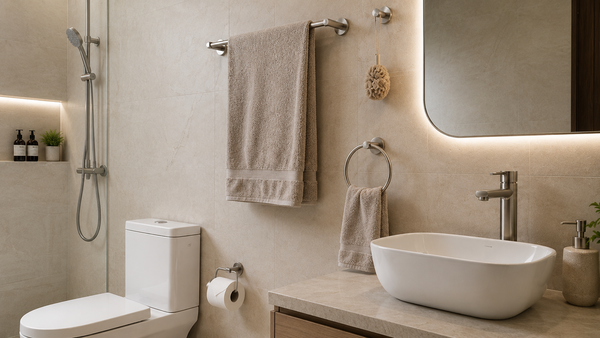
TL;DR: Start with the cabinet width, because it decides everything else. Design convention puts the mirror at roughly 70 to 90 percent of the cabinet width and never wider. Match your basin type to the cabinet before you fall for a finish, and in a Malaysian wet bathroom coordinate durability as carefully as you coordinate style, since the weakest material sets the lifespan of the whole vanity set.

Introduction
Buying a basin, a cabinet and a mirror separately is easy. Making them look like they were meant for each other is the hard part. Plenty of Malaysian bathrooms end up with three perfectly nice pieces that somehow feel wrong together: a mirror that floats too high, a basin that crowds the counter, or finishes that quietly clash.
This guide is about the pairing, not the individual products. We will work through proportion, height, basin compatibility and finish matching in millimetres rather than the inches every overseas guide uses, and finish with the durability question that matters most in our climate. If you would rather skip the coordination work entirely, a ready-matched basin cabinet set solves much of it in one purchase.
1What is a vanity set?
Quick answer: A vanity set is the coordinated group of three pieces around your bathroom sink: the basin you wash in, the cabinet that supports it and hides the plumbing, and the mirror above. Sold together they share sizing and finish; bought separately you coordinate them yourself.
Each piece has a job, and each constrains the others:
- The basin. Determines counter space, working height and where the tap sits. See the wash basin range for the main types.
- The cabinet. Sets the width of the whole arrangement and carries your storage.
- The mirror. Takes its width, height and position from the two below it.
Notice the direction of that dependency. The mirror answers to the cabinet, and the basin dictates height. Get the order of decisions right and the coordination mostly takes care of itself.
2Start with cabinet width: it drives everything
Quick answer: Measure your available wall width first, then choose the cabinet. Malaysian basin cabinets commonly run from 600mm to 1200mm. Once that number is fixed, your mirror width, basin size and even tap choice all follow from it. Choosing the mirror first is the most common way people end up with a set that looks off.
The cabinet is the anchor. It is the widest, heaviest, most permanent piece, and it is the one constrained by your plumbing and your wall. Everything else is easier to swap later.
So measure the wall, subtract clearance for doors and any adjacent fittings, and settle on a cabinet width from the basin cabinet range before you look at anything else. Write that number down; the rest of this guide works from it.
3Mirror-to-cabinet width pairing chart
Interior design guidance consistently puts mirror width at about 70 to 90 percent of the vanity width, and never wider than the cabinet itself. Overseas sources quote this in inches, so here it is converted for the cabinet widths actually sold in Malaysia.
| Cabinet width | Mirror width (70-90%) | Typical setting |
|---|---|---|
| 600mm | 420 - 540mm | Compact condo bathroom |
| 750mm | 525 - 675mm | Standard family bathroom |
| 900mm | 630 - 810mm | Larger main bathroom |
| 1200mm | 840 - 1080mm | Landed home, or twin basins |
The one hard rule: do not go wider than the cabinet. A mirror that overhangs pulls the eye away from the basin and makes the whole vanity set look top-heavy.
4Choosing the basin: type changes the whole set
Quick answer: A countertop or vessel basin sits on top of the cabinet and raises your working height by roughly 100 to 150mm, which pushes the mirror up too. An under-counter or integrated basin keeps the height standard and the counter clear. Pick the basin type before the mirror, or you will be re-drilling the wall.
This is the trap that catches people out. A vessel basin looks superb in photos, but it changes the geometry of the entire arrangement. The rim ends up noticeably higher than a standard counter, so the tap must be taller, the mirror must move up, and a comfortable height for one household member can be awkward for another.
None of that makes vessel basins a bad choice. It simply means the decision has to come early, while the mirror is still on paper. Browse the wash basin collection and settle the type before you commit to anything above it.
5Basin type compatibility and height
| Basin type | Sits | Effect on height | Mirror adjustment |
|---|---|---|---|
| Countertop / vessel | On top of the counter | Raises rim ~100-150mm | Mount noticeably higher |
| Semi-recessed | Partly into the counter | Slight rise | Small upward shift |
| Under-counter | Below the counter | Standard height, clear top | Standard position |
| Integrated | Moulded into the top | Standard, seamless | Standard position |
| Wall-hung basin | On the wall, no cabinet | You set the height | Follows your chosen height |
Not sure which basin suits your cabinet?
Our showroom team can pair them properly and flag any height issues before you buy. WhatsApp your nearest Big Bath branch with your measurements.
6Getting the heights right

Quick answer: Common practice puts the centre of the mirror around 1500 to 1650mm from the floor, with the bottom edge roughly 125 to 250mm above the counter or tap. Centre the mirror over the basin, not over the wall, and adjust upward if you have chosen a vessel basin or a tall tap.
Height is where a technically correct vanity set still manages to feel wrong. Three points settle it.
Centre on the basin, not the wall
If your basin is not perfectly centred in the cabinet, follow the basin. People use the mirror while standing at the tap, so aligning to the basin looks right and works better, even if the wall spacing ends up slightly uneven.
Leave a gap above the counter
A gap of roughly 125 to 250mm between the counter or tap and the bottom of the mirror keeps the two visually connected without inviting splashes onto the glass. Too tight looks cramped; too generous makes the mirror look like it is drifting away.
Suit the people using it
The standard eye-level range suits most adults, but a household of taller or shorter users is worth accommodating. A taller mirror is the easy fix, since it serves a wider range of heights. Options in the bathroom mirror range cover a good spread of sizes.
7Matching finishes without visual noise
Quick answer: Pick one metal finish and repeat it across the tap, mirror frame and cabinet handles. Mixing three different metals is what makes a bathroom feel busy even when every individual piece is attractive. If the cabinet already has hardware, let that finish lead.
Finish coordination is simpler than it looks once you accept a single constraint: choose one metal and stay with it. Chrome with chrome, matt black with matt black. The mirror frame, tap and handles should read as a family.
That does not mean everything must be identical. Contrast between the cabinet colour and the metal is what gives a vanity set character. A white cabinet takes almost any metal; a dark cabinet suits warm tones better than cold chrome. What creates visual noise is not contrast, it is three competing metals in one small room. A framed mirror cabinet can double as both your storage and your finish statement.
8Finish coordination matrix
| Cabinet finish | Works well with | Use with care |
|---|---|---|
| White / light | Chrome, matt black, brushed steel | Heavy ornate frames |
| Dark / charcoal | Matt black, matt gold, brushed brass | Polished chrome can read cold |
| Wood-look | Frameless, matt black, warm metals | High-polish finishes |
| Stainless steel | Brushed steel, chrome, frameless | Warm golds can clash |
| Aluminium modern | Matt black, aluminium, frameless LED | Traditional carved frames |
9Buy as a matched set, or mix and match?
Quick answer: A matched set removes the guesswork: the sizing, finish and basin fit are already resolved, and it is usually faster and cheaper than sourcing three pieces. Mixing gives you a more personal result and lets you spend where it matters, but you take on the proportion and finish work yourself.
Neither approach is better; they suit different people. If this is your first renovation, or you are furnishing several bathrooms, a coordinated vanity set is the low-risk route and looks deliberate by default.
Mix and match earns its keep when you have a clear vision, an unusual wall width, or one piece you genuinely love. Just apply the rules above rather than trusting the showroom lighting.
10Set or mix: which suits you?
| If this is you | Better route | Why |
|---|---|---|
| First-time renovator | Matched set | Sizing and finish already resolved |
| Tight budget | Matched set | Usually better value than three purchases |
| Replacing one broken piece | Mix | Match the survivors, not a whole new set |
| Awkward or narrow wall | Mix | Sets may not come in your width |
| Design-led renovation | Mix | Freedom to make a statement piece |
| Multiple bathrooms at once | Matched set | Consistency and simpler ordering |
11Coordinate durability, not just style
Quick answer: In a Malaysian wet bathroom, the weakest material sets the lifespan of the whole vanity set. A rust-proof stainless cabinet paired with a cheap steel-framed mirror gives you a set that fails in one place and looks mismatched forever. Match moisture resistance across all three pieces, not just colour.
This is the consideration every overseas guide misses, because it is written for dry bathrooms where the vanity sits well away from the shower. Our bathrooms are wet bathrooms: bidet spray, open showers, floor washing, constant humidity. Every piece of your vanity set lives in that.
The practical consequence is straightforward. Coordinating style is about how the set looks on day one. Coordinating durability is about whether it still looks that way in year five. A beautifully matched set is no bargain if the mirror frame is rusting while the cabinet is still perfect, because you cannot replace one piece without breaking the match.
So when you compare options, check the material of all three: rust-proof stainless, aluminium or PVC for the cabinet, an aluminium or treated frame on the mirror, and quality ceramic or resin for the basin. The basin cabinet range lists the material of each model so you can compare properly.
Key takeaway: Match the proportions so the set looks right today, and match the moisture resistance so it still looks right years from now. Both matter; only one gets discussed.
Frequently asked questions
What size mirror should go above my basin cabinet?
Design convention puts the mirror at about 70 to 90 percent of the cabinet width, and never wider than the cabinet. For a 750mm cabinet that means roughly 525 to 675mm. Centre it over the basin rather than the wall.
How high should a bathroom mirror be hung?
Common practice puts the centre of the mirror around 1500 to 1650mm from the floor, with the bottom edge roughly 125 to 250mm above the counter or tap. Raise it if you have a vessel basin or a tall tap.
Should I buy a vanity set or separate pieces?
A matched set is easier and usually better value, since sizing, finish and basin fit are already resolved. Mix and match if you have an unusual wall width, a clear design vision, or you are replacing just one piece.
Can I mix metal finishes in a bathroom?
You can, but keep it to one dominant metal across the tap, mirror frame and handles. Three competing finishes in a small bathroom is what makes an otherwise attractive set feel busy.
Does a vessel basin change my mirror height?
Yes. A countertop or vessel basin raises the rim by roughly 100 to 150mm, so the tap is taller and the mirror needs to sit higher. Decide the basin type before you fix the mirror position.
Conclusion
A vanity set that feels right is mostly a matter of sequence. Fix the cabinet width first, choose the basin type second, then size and place the mirror against both. Keep the metals to one family, and the coordination that looks effortless in showrooms becomes fairly simple arithmetic.
Then add the step nobody overseas has to think about: in a Malaysian bathroom, match the durability as carefully as the colour. A set built to survive our humidity will still look coordinated long after a prettier, weaker one has started to fail.
Build your vanity set at Big Bath.
Bring your wall measurements and our showroom team will pair basin, cabinet and mirror properly, check the heights, and match the finishes and materials to your bathroom. With showrooms nationwide and over 15,000 five-star reviews, expert help is close by.
Find a Big Bath Showroom →