Toilet Seat Replacement: Sizes, Fit and Material Types
TL;DR: There is no universal toilet seat size. A seat is sized to your pan, so you measure the pan length, width and the distance between the fixing holes before you shop for anything. Then decide the fixing type by whether you can reach underneath the pan, and choose the material by how much sun and humidity the room gets. Get those three right and the seat lasts; get any one wrong and it rocks, stains or will not bolt down at all.
1. Introduction: the seat is sized to the pan, not to a standard
Quick Answer: Toilet seat replacement fails for one reason more than any other people buy by brand or by picture instead of by measurement. Take three measurements off the pan first: overall length, widest width, and the centre-to-centre spacing of the two fixing holes.
A toilet seat looks like the most interchangeable part in a bathroom. It is not.
Pans vary in length by several centimetres between models, the fixing holes are not always the same distance apart, and some pans can be reached from below while others are sealed against the wall or boxed in. A seat that suits one bowl can sit proud of the next one by a finger's width, and that gap is exactly where it starts to rock.
The good news is that the whole job is decided before you buy anything. Three numbers off a tape measure, one look underneath the pan, and one honest question about how much daylight the room gets — that is the entire specification.
This guide walks through those measurements, the shapes they point to, the two fixing systems and which one your pan allows, the material choices and what each one actually does in Malaysian conditions, and the point at which replacing the seat stops making sense. The video below covers the measuring part visually if you would rather watch it done.
Watch: how to measure a toilet seat before you buy
A short walkthrough of the three measurements, taken off the pan rather than off the old seat.
2. The three measurements that decide the fit
Quick Answer: Measure the pan, never the old seat — the old one may have been the wrong size all along. You need length from the fixing-hole centreline to the front lip, the widest width across the bowl, and the centre-to-centre distance between the two fixing holes.
Take all three before you look at a single product page. It takes two minutes.
- Find the fixing holes and mark the midpoint between them. Lift the old seat out of the way or remove it. The two holes at the back of the pan are your datum for everything else.
- Measure the length. Run the tape from that midpoint straight forward to the outside edge of the front of the bowl. This is the number that separates one shape from another.
- Measure the width. Across the bowl at its widest point, outside edge to outside edge.
- Measure the hole spacing. Centre of one hole to centre of the other. If this does not match the seat you are buying, nothing else matters.
- Look underneath the back of the pan. Can you get a hand and a spanner to the underside of those holes? Your answer decides the fixing type in section four.
| Measurement | Taken from | What it decides | If it is wrong |
|---|---|---|---|
| Length | Hole centreline to front lip | The seat shape family | Seat overhangs or leaves bowl exposed |
| Width | Widest point across the bowl | Whether the lid sits flush | Lid edges hang over the rim and chip |
| Hole spacing | Centre to centre of the fixings | Whether it bolts down at all | Hinges will not line up — hard stop |
| Underside access | Reaching below the pan | Top-fix or bottom-fix | You cannot tighten the nuts |
Compiled fitting reference for replacing a toilet seat on a domestic pan. Describes the relationship between each measurement and the fit outcome; it is a planning aid, not a manufacturer specification.
One habit worth breaking: measuring the seat you are removing. If the previous seat was a near-miss — and a surprising number are — you will replicate the mistake exactly.
Key takeaway: Length, width, hole spacing, underside access. Measure the pan, not the old seat.
3. Shapes: what your length measurement is telling you
Quick Answer: Length puts your pan into a shape family round, D-shape, oval or square-fronted. In Malaysia the D-shape and oval dominate, because most bowls sold here are modern washdown pans rather than the older round profile common in North American guides.
The shape is a consequence of the measurement, not a separate choice.
| Shape | Front profile | Typically found on | Seen here |
|---|---|---|---|
| D-shape | Flat-fronted curve | Modern close-coupled and rimless pans | Very common |
| Oval / elongated | Long, gently pointed | Full-size washdown pans | Very common |
| Round | Short, near-circular | Older pans and compact installations | Less common now |
| Square-fronted | Straight edges, tight radii | Designer and wall-hung ranges | Occasional |
| Model-specific | Matched to one pan only | Smart toilets and one-piece designs | Growing |
Compiled shape reference based on the pan profiles stocked in Big Bath's water closet range. Prevalence is a qualitative observation of the Malaysian market, not survey data.
That last row is the one that catches people out. Smart toilets and many one-piece designs use a seat moulded for that pan alone, often with an integrated bidet function and its own electrical connection. A generic replacement does not exist for those — the seat comes from the manufacturer or it does not come at all. Big Bath's close-coupled WC sets ship with the matching soft-close seat included for exactly this reason, so a set purchase removes the guesswork entirely.
Key takeaway: D-shape and oval cover most Malaysian pans. Smart and one-piece toilets usually need the manufacturer's own seat.
4. Top-fix or bottom-fix: the access question
Quick Answer: Bottom-fix seats are tightened with a nut underneath the pan. Top-fix seats are tightened from above using an expanding fitting dropped into the hole. If you cannot get your hand under the back of the pan, you need top-fix this is not a preference, it is a constraint.
Check this before you buy, because the two are not interchangeable at the point of installation.
Bottom-fix is the traditional arrangement. A bolt drops through the hole in the pan and a nut goes on underneath, which is why it holds so well once it is done up but it needs a full reach beneath the back of the bowl, and on a pan pushed tight to the wall that reach does not exist. It suits open-backed pans with clearance around them.
Top-fix solves the access problem. The fitting drops into the hole and expands as you tighten it from above, so nothing has to happen underneath at all. That makes it the only workable choice on back-to-wall, boxed-in and wall-hung pans. The trade-off is that an expanding fitting can loosen with use, so it is worth a check with a screwdriver once or twice a year.
Quick-release is worth paying attention to whichever system you end up with. It lets the seat lift off its hinges in one movement, which turns the hinge area reliably the dirtiest part of any toilet into a surface you can actually clean properly rather than poke at. That matters more here than in a temperate climate, and it is the single upgrade most people notice in daily use.
Key takeaway: Reach under the pan before you buy. No access means top-fix, and quick-release hinges are worth having either way.
Replacing the seat because the hinges have gone black?
That is a cleaning-access problem as much as a hardware one — see the routine that keeps hinges clean →
5. Materials: what each one actually does here
Quick Answer: Urea formaldehyde (UF) is the dense, heavy, glossy material used on most quality seats and it holds its finish. Polypropylene is lighter and cheaper but flexes and yellows. Moulded wood looks warm but does not enjoy a humid bathroom. In Malaysia the deciding factors are humidity and daylight, not weight.
Rating the common materials against the things that actually shorten a seat's life here makes the trade-off visible.
| Material | Handles humidity | Resists yellowing | Best for |
|---|---|---|---|
| Urea formaldehyde (UF) |
|
|
Any bathroom; the default choice |
| Polypropylene (PP) |
|
|
Low-cost or short-term replacement |
| Duroplast / thermoset |
|
|
Shared or heavily used bathrooms |
| Moulded wood |
|
|
Dry, well-ventilated powder rooms only |
| Soft / padded |
|
|
Comfort priority, short service life |
Compiled comparison of toilet seat materials against Malaysian bathroom conditions sustained high humidity and strong daylight. Bar lengths express relative suitability as a planning aid, not measured laboratory performance.
Two notes worth carrying into the shop. Moulded wood is the classic mistake in a wet Malaysian bathroom: the core absorbs moisture through the fixing holes and the underside, then swells and lifts the coating. And a padded seat that feels lovely in a showroom has a seam, and a seam in this climate becomes a place things grow. If you want comfort, the better route is a good UF seat with soft-close rather than a soft top surface.
Key takeaway: UF or thermoset for anything that gets daily use. Keep wood and padded seats out of humid bathrooms.
6. Soft-close hinges: what fails, and why
Quick Answer: A soft-close seat drops slowly because of a damper in the hinge. The damper is the part that wears out, not the seat itself. When a seat starts slamming again, the lid is usually fine the hinge cartridge has failed and can often be replaced on its own.
Understanding this saves buying a whole new seat every time the mechanism gives up.
The damper is a small sealed unit that resists rotation. It gets a hard life in a bathroom: the seat is lifted and dropped several times a day, the hinge sits in the wettest, warmest spot in the room, and it collects everything the flush throws at it. Two things kill it early. Forcing the lid down instead of letting it fall breaks the internal resistance, and cleaning products left to pool around the hinge attack the fittings.
The rest of the seat rarely fails at the same time. Cracks come from weight applied to a seat that is not fully lowered, and discolouration comes from sunlight rather than use. So when a seat starts slamming, check whether the manufacturer sells a hinge kit before you replace anything many do, and on a set-supplied seat it is often stocked alongside the other water closet spare parts.
Key takeaway: Slamming means the damper, not the seat. Ask about a hinge kit before replacing the whole thing.
7. Replace the seat, the hinge, or the whole toilet?
Quick Answer: Replace the hinge if the seat is sound and only the closing action has failed. Replace the seat if it is cracked, yellowed or the wrong size. Replace the pan only if the ceramic is damaged, the flush has genuinely weakened, or you want a bowl that is easier to keep clean.
Matching the symptom to the right level of work keeps a small job small.
| Symptom | Likely cause | What to replace | Check first |
|---|---|---|---|
| Lid slams shut | Worn soft-close damper | Hinge kit only | Whether a kit exists for the model |
| Seat rocks side to side | Loose fixings, or wrong size seat | Tighten, then seat if it persists | Hole spacing against the pan |
| Yellowed or dull | Daylight on a PP seat | Seat, in UF this time | How much sun the room gets |
| Hairline crack at a hinge | Weight on a partly raised lid | Seat, without delay | Nothing — a crack will spread |
| Stains that never clear | Etched glaze on the pan | The pan, not the seat | Trap type and setout distance |
Compiled diagnostic reference for toilet seat and pan replacement decisions. Guidance is indicative; a physical inspection settles borderline cases.
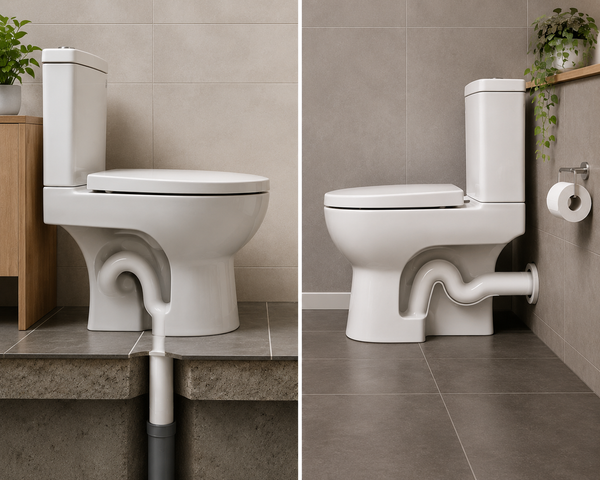
That final row is the one that changes the size of the job. If the ceramic itself is the problem, the seat was never going to fix it, and the replacement conversation starts with the trap a new pan has to match the existing drain, so the S-trap or P-trap setout decides what will physically fit before anything else does. Big Bath's water closet range lists that setout in the product title, which makes the check quick.
Key takeaway: Match the fix to the symptom. Hinge for slamming, seat for cracks and yellowing, pan only for damaged ceramic.
8. Conclusion: measure, check access, then choose
Toilet seat replacement is a fifteen-minute job that people get wrong in the shop rather than at the toilet. Almost every returned seat comes back for one of three reasons: the hole spacing did not match, the pan could not be reached from below, or the shape was bought from a photograph.
So the order is fixed. Measure length, width and hole spacing off the pan. Put a hand under the back of the pan and find out whether bottom-fix is even possible. Then choose the material for the room you actually have a bathroom that is warm and damp most of the year, and possibly sunlit, which rules out wood and makes UF the sensible default.
After that, the choice is genuinely just about looks and budget. And if the seat turns out to be the wrong question because the ceramic underneath it is finished, that is worth knowing early, while it is still a small decision rather than an urgent one. Bringing the three measurements to a showroom settles both questions in one visit.
9. Frequently asked questions
Are toilet seats a standard size in Malaysia?
No. Pans vary in length, width and fixing-hole spacing between models, so a seat is sized to the pan rather than to a national standard. Measure your own bowl before buying anything.
How do I measure my toilet for a replacement seat?
Mark the midpoint between the two fixing holes, then measure forward to the front edge of the bowl for length, across the widest part for width, and centre to centre between the holes for spacing. Take all three off the pan, not the old seat.
What is the difference between top-fix and bottom-fix toilet seats?
Bottom-fix seats are tightened with a nut underneath the pan, so you need to reach below it. Top-fix seats tighten from above using an expanding fitting, which is the only option on back-to-wall, boxed-in or wall-hung pans.
Which toilet seat material lasts longest in a humid bathroom?
Urea formaldehyde and other thermoset materials. They are dense, hold their gloss and are unaffected by sustained humidity. Moulded wood swells through the fixing holes, and padded seats develop seams that trap moisture.
Can I replace just the soft-close hinges instead of the whole seat?
Often yes. The damper inside the hinge is the part that wears out, and many manufacturers sell a replacement hinge kit. Check whether one exists for your model before buying a complete seat.
Why does my new toilet seat rock?
Either the fixings need tightening, or the hole spacing does not match the pan and the seat is sitting on the wrong footprint. Re-measure the centre-to-centre distance between the fixing holes and compare it with the seat specification.
Not sure which seat fits your pan?
Send your three measurements length, width and hole spacing and a Big Bath specialist will confirm what fits, including whether a hinge kit would solve it instead.
Talk to a bathroom specialist