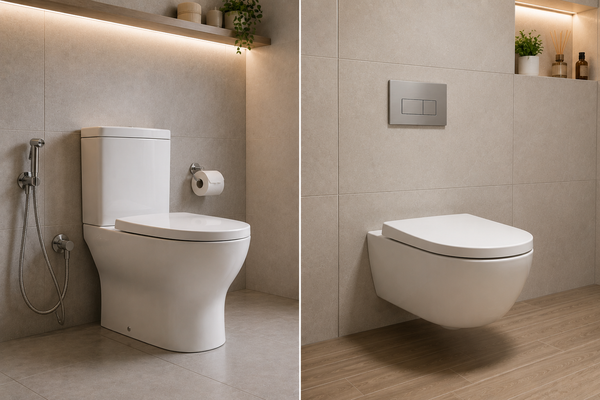
Flush Valve vs Cistern: How Malaysian Toilets Flush
TL;DR: "Flush valve" means two entirely different products in Malaysia — the plastic mechanism inside a cistern, and the mains-pressure device on a shop or office toilet with no tank at all. They are not alternatives you get to pick between. A cistern fills at a trickle and works on any domestic supply; a direct flush valve delivers the whole flush at once and needs pipework sized for it. Your building decides, not your preference.
1. Introduction: one term, two products
Quick Answer: Ask for a flush valve in Malaysia and you may be handed either the outlet mechanism that sits inside a cistern, or a chrome device that bolts to a wall and flushes a toilet straight from the mains. Both are called flush valves and they solve different problems.
This is the most confusing piece of terminology in Malaysian sanitary ware, and it costs people money regularly.
A homeowner whose toilet has started trickling searches for a flush valve, finds a chrome push-button unit designed for a shophouse toilet, and orders it. It arrives and fits nothing. Meanwhile a shop owner replacing a squat pan flusher is shown a plastic dual-flush cartridge for a domestic cistern.
The terms are both correct. The products are unrelated. And the choice between the two systems, where a choice genuinely exists, is settled by something most people never think about how much water your incoming pipe can move in a couple of seconds.
This guide separates the two meanings, explains what each system demands of the plumbing, opens up a dual-flush cistern to show where the water actually goes, and sets out which system belongs in which kind of building. The video below covers the cistern side in detail.
Watch: fitting a dual-flush valve and fill valve in a cistern
A full walkthrough of the two mechanisms inside a domestic cistern, including what a leaking flush looks like from the inside.
Source: How to fit a toilet flush valve & fill valve — POUSE around the HOUSE
2. The two things called a flush valve
Quick Answer: A cistern flush valve is a plastic outlet mechanism that lets stored water out of a tank. A direct flush valve is a metal device connected to the mains that opens for a measured moment and closes itself. One releases stored water, the other meters live supply.
Reading the difference off the physical part takes seconds once you know what to look for.
| Aspect | Cistern flush valve | Direct flush valve |
|---|---|---|
| Where it sits | Inside the tank, on the outlet | On the wall above the pan |
| Typically made of | Moulded plastic and rubber | Chromed brass |
| Where the water comes from | Stored in the cistern beforehand | Straight off the supply pipe |
| Ready for the next flush | After the cistern refills | Immediately |
| Usually found in | Homes, condos, hotels | Shops, offices, schools, mosques |
| Also used on | Concealed in-wall cisterns | Squat pans and urinals |
Compiled comparison of the two flush valve product types stocked for the Malaysian market. Describes typical usage rather than an exhaustive classification.
That last row explains why direct flush valves are so visible in Malaysia even though most homes do not have one. Squat pans and urinals have no tank at all, so a direct valve is the only way to flush them. Big Bath's flush valve range reflects that split directly: alongside WC units it lists exposed and concealed squatting-pan valves, self-closing and push-button urinal valves, and sensor versions of both.
Key takeaway: Plastic and inside a tank means cistern valve. Chrome and on the wall means direct valve. They are not substitutes.
3. What each system demands of the pipework
Quick Answer: A cistern refills slowly, so it barely registers on the building's water supply. A direct flush valve has to deliver the entire flush in a few seconds, so it needs a much larger pipe and a supply that will not sag when several fire at once. This is the constraint that decides which you can have.
It is the difference between filling a bucket over a minute and tipping one over in three seconds.
A cistern is a buffer. It draws water at whatever slow rate the supply allows and stores it until you need it, which is why a domestic toilet works perfectly on a modest pipe shared with a shower and a kitchen tap. A direct flush valve has no buffer at all: the flush is whatever the pipe can deliver in that moment. Industry guidance on the two approaches puts a cistern's refill demand at roughly a tenth of a litre per second against around one and a half litres per second for a flush valve, which is why one is a plumbing afterthought and the other has to be designed in — as this comparison of the two systems sets out.
| Requirement | Cistern system | Direct flush valve | Why it matters |
|---|---|---|---|
| Pipe capacity needed |
|
|
Decides whether retrofitting is possible |
| Tolerates low pressure |
|
|
Upper floors and older buildings |
| Handles rapid repeat use |
|
|
Public and high-traffic washrooms |
| Space taken in the room |
|
|
Tight shophouse and office cubicles |
| Quiet operation |
|
|
Bedrooms next to bathrooms |
Compiled comparison of cistern and direct flush valve systems. Bar lengths express relative demand and suitability as a planning aid, not measured flow or acoustic data.
The practical upshot for anyone renovating a home: a direct flush valve is not a domestic upgrade. Fitting one to a house or condo would mean re-running the supply pipe to that toilet in a larger size, and in a high-rise it would also mean a conversation with the building about what the riser can take. That is why the tankless commercial look almost never appears in Malaysian homes, whatever it costs.
Key takeaway: A cistern sips, a flush valve gulps. Pipe size, not preference, decides which your building supports.
Toilet running, hissing or flushing weakly?
Each symptom names its own component — work backwards from the symptom to the part →
4. Inside a dual-flush cistern
Quick Answer: A dual-flush cistern holds one volume of water and releases either part of it or all of it, depending on which button you press. Big Bath's close-coupled sets use a typical 3-litre half flush and 6-litre full flush, with a soft-close seat supplied as part of the set.
The two buttons are not two tanks. They are two stopping points on the same one.
| Stage | What happens | Component acting | Fault if it goes wrong |
|---|---|---|---|
| Button pressed | Rod lifts the flush valve seal | Push button and rod | Button sticks or nothing happens |
| Half flush | Valve reseats early, around 3 litres | Dual-flush cartridge | Both buttons give a full flush |
| Full flush | Valve stays open, around 6 litres | Flush valve body | Weak or incomplete clearing |
| Water enters the pan | Flows through rim channels | The pan itself | Uneven flow, streaking left behind |
| Refill | Tank refills, trap reseals | Fill valve | Slow refill or continuous hiss |
Compiled operating sequence for a dual-flush close-coupled cistern. Flush volumes are the typical 3-litre and 6-litre figures quoted for Big Bath's close-coupled WC sets, not a measurement of any individual unit.
One row deserves emphasis. If the flush feels weak but the cistern is full and both buttons work, the fault is usually in the pan rather than the valve — partly blocked rim channels send water down one side instead of around the bowl. That is a cleaning job, and it is misdiagnosed as a failed flush valve more often than anything else on this list.
Key takeaway: Dual flush is one tank with two stopping points. A weak flush from a full tank usually means the pan, not the valve.
5. Concealed cisterns: the third thing people mean
Quick Answer: A concealed or in-wall cistern is still a cistern. It stores water and refills slowly exactly like a visible one — it is just hidden behind a wall or duct, operated by a flush plate. It is not a direct flush valve, and it does not need commercial-sized pipework.
The tankless appearance is what causes the confusion.
Because the wall behind a concealed installation looks flat and there is nothing visible but a plate, people assume the toilet is fed straight off the mains like an office unit. It is not. The tank is simply in the wall, and the plate that operates it is doing the same job as a push button on a visible lid.
Two things follow from that. First, the plumbing demands are domestic, so a concealed cistern is a realistic renovation choice in a home where a direct flush valve is not. Second, the flush plate is a service access point as well as a design feature — it comes off to reach the fill valve and flush valve inside. Anyone specifying one should confirm that access is genuine and that the parts behind it are obtainable, because a wall is an expensive place to discover otherwise. That constraint is part of the wider trade-off between wall-hung and floor-mounted pans.
Key takeaway: Hidden tank still means cistern. The flush plate is a service hatch — check the parts behind it are available.
6. Which system belongs where
Quick Answer: Homes and condos use cisterns, visible or concealed. Shops, offices, schools and places of worship use direct flush valves, usually with sensor operation in the busiest of them. Squat pans and urinals always use direct valves because they have no tank.
Matching the setting to the system removes almost all of the ambiguity.
| Setting | System | Why | Watch out for |
|---|---|---|---|
| House or condo | Close-coupled cistern | Works on any domestic supply | Trap setout must match the drain |
| Renovated bathroom | Concealed cistern | Same demands, cleaner appearance | Service access through the plate |
| Shop or small office | Direct flush valve | Instant reuse, nothing to vandalise | Supply pipe must be sized for it |
| High-traffic washroom | Sensor flush valve | Hands-free, consistent volume | Needs power or battery servicing |
| Squat pan | Direct flush valve | There is no tank to store water | Exposed or concealed body choice |
| Urinal | Self-closing or sensor valve | Short metered flush per use | Manual buttons get left running |
Compiled specification guide based on the flush valve and water closet types stocked for the Malaysian market. Building-specific supply conditions should be confirmed before ordering.
The one genuine decision on that list is the third and fourth rows. A small shop with a single cubicle rarely justifies sensor operation; a washroom serving a busy office floor usually does, because a manual button that gets left half-pressed wastes far more water than the sensor costs. Everything else on the list is decided for you by the building.
Key takeaway: Homes get cisterns, commercial gets direct valves, and the only real choice is manual versus sensor in busy washrooms.
7. What this means for servicing
Quick Answer: Cistern mechanisms are cheap, plastic and replaced whole every few years. Direct flush valves are brass, last far longer and are rebuilt with a seal kit rather than swapped. Knowing which you have tells you what to ask for.
The two systems age in completely different ways, and the shopping conversation follows from that.
A cistern's plastic parts are consumables. The seal hardens in warm water, the flush starts to trickle, and the fix is a new cartridge or a new valve assembly a small item you can carry home in one hand. Because the mechanism is inexpensive, nobody rebuilds one, and a set-supplied unit is usually best replaced with the same part rather than a near-match.
A direct flush valve is a piece of brass engineering with a metering mechanism inside it. It survives years of hard public use, and when it eventually starts running on or refusing to close, the answer is usually a service kit of internal seals and a clean. Replacing the whole body is unusual, and a valve that has genuinely failed is often mounted on the wrong supply pressure rather than worn out.
For either system, the same rule from the rest of the catalogue applies: identify the part precisely before ordering. Big Bath lists WC, squatting and urinal valves separately in the flush valve range, and the broader sanitary ware range covers the pans they serve.
Key takeaway: Cistern mechanisms get replaced, brass flush valves get rebuilt. Ask for the right thing and the job is short.
8. Conclusion: the building has already decided
Flush valve versus cistern reads like a choice and mostly is not one. If you live in a Malaysian house or condo, your toilet has a cistern, and the only real decision is whether that cistern is visible or hidden in the wall. If you are fitting out a shop, an office or a surau, the pipework will support a direct flush valve and the space almost certainly favours one.
Where the question does matter is in the shop. Knowing which of the two products you are actually asking for turns a frustrating errand into a two-minute one, and it stops the common mistake of ordering a commercial chrome unit for a domestic tank.
And whichever system you have, the same two habits keep it working: check whether a weak flush is really the pan before blaming a valve, and confirm that the parts for your model will still exist in a few years. Those two questions cover almost everything a toilet will ever ask of you. If you are replacing the pan as well, the trap setout is the measurement that comes first, and the water closet range lists it on every product.
9. Frequently asked questions
What is the difference between a flush valve and a cistern?
A cistern stores water and releases it when you flush. A direct flush valve has no tank and meters water straight from the supply pipe. Confusingly, the outlet mechanism inside a cistern is also called a flush valve, which is why the term means two different products.
Can I fit a direct flush valve in my house?
Usually not without re-plumbing. A direct flush valve delivers the whole flush at once and needs a much larger supply pipe than a domestic toilet is fed with. In a high-rise it would also depend on what the building's riser can supply.
Is a concealed cistern the same as a flush valve toilet?
No. A concealed cistern is still a cistern it stores water and refills slowly, it is just hidden in the wall and operated by a flush plate. Its plumbing requirements are domestic, not commercial.
How much water does a dual flush toilet use?
Big Bath's close-coupled WC sets use a typical 3-litre half flush and 6-litre full flush from a single tank. The two buttons are two stopping points on the same volume of stored water, not two separate reserves.
Why is my flush weak when the cistern is full?
Usually the rim channels in the pan are partly blocked, so water runs down one side instead of around the bowl. That is a cleaning job. Check it before assuming the flush valve has failed.
Why do squat pans and urinals always use flush valves?
Because they have no tank to store water in. A direct flush valve is the only way to deliver a measured flush to them, which is why exposed, concealed and sensor versions are all stocked for those fittings.
Fitting out a shop, office or home bathroom?
Tell a Big Bath specialist what the building is and what the supply pipe looks like, and they will confirm which flushing system it will actually support before you order anything.
Talk to a bathroom specialist