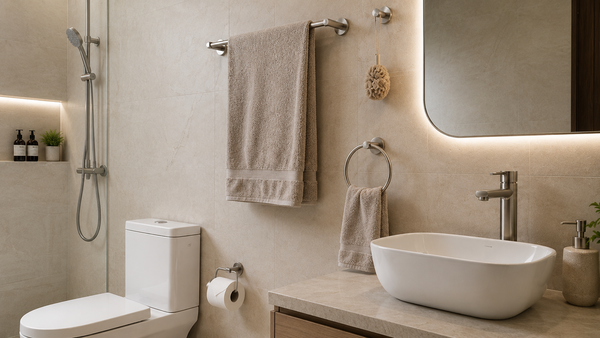
There are so many bathroom sink and wash basin designs on the market now that the choice can feel overwhelming. As picky as we are, we're spoiled for options: countertop, wall-hung, pedestal, vanity, glass, stone. So which kind is actually best for a Malaysian bathroom?
The honest answer is "it depends," but in a useful way. Once you know your space, how the basin will be used, and roughly what you want to spend, the field narrows fast. This guide walks through the types, sizes, materials and prices so you can pick with confidence instead of guessing.
The short video below is a handy primer on measuring your basin space before you buy.
How to Measure a Bathroom Basin
Source video: Victorian Plumbing on YouTube
1Does the type of bathroom sink really matter?

Quick Answer: Yes. The sink shapes how a bathroom feels and works — its footprint decides your floor space, its style sets the look, and whether it has a cabinet decides your storage. In a small bathroom especially, the wrong basin makes the room feel cramped and cluttered.
A basin isn't just a bowl to wash your hands. It's often the first fixture you see when you walk in, and the one you use most. Get it right and the room feels open, tidy and easy to clean. Get it wrong — too big, too deep, no storage, and you feel the squeeze every morning.
Before you fall for a design, it pays to think like a planner: how much space you have, how the basin will be used (just hand-washing, or shaving and teeth too), and where your storage will go. A quick browse of our bathroom sanitary ware range shows just how much the type changes the feel of a room.
2The main types of bathroom sink in Malaysian homes
Quick Answer: The common types are countertop (vessel), drop-in, undermount, wall-hung, pedestal and the basin cabinet (vanity). They differ mainly in footprint and storage. Wall-hung and pedestal save the most floor; basin cabinets give the most storage; vessel and countertop basins make the biggest style statement.
Here are the basin styles you'll meet in a local showroom, in plain terms:
- Countertop / vessel. Sits on top of the counter like a bowl — a bold, designer look. Browse countertop wash basins for that statement feel.
- Drop-in. Drops into a hole in the counter with a visible rim. The everyday, DIY-friendly option.
- Undermount. Fits below the counter for a clean, easy-wipe finish; needs a solid worktop. See under-counter basins.
- Wall-hung / wall-mounted. Fixes to the wall and frees the floor beneath, ideal for small bathrooms. See the wall-hung basin.
- Pedestal. A basin on a slim column that hides the pipework. Classic and compact, with no storage.
- Basin cabinet (vanity). A basin paired with a storage cabinet, the most practical for families.
| Sink type | Best for | Space used | Storage | From (illustrative) |
|---|---|---|---|---|
| Wall-hung | Small bathrooms |
|
None | ~RM 150 |
| Pedestal | Powder rooms |
|
None | ~RM 200 |
| Countertop / vessel | Statement look |
|
Counter below | ~RM 150 |
| Drop-in / undermount | Everyday vanities |
|
Cabinet below | ~RM 120 |
| Basin cabinet (vanity) | Family bathrooms |
|
Most | ~RM 600 |
Illustrative footprint and entry pricing; actual specs and prices vary by model.
Planning a bathroom upgrade soon?
See the full range of basins and vanity cabinets before you commit. Browse Big Bath basins →
3Sizes, heights and clearances: making the basin fit
Quick Answer: Aim for a basin width that suits your space (compact 400mm up to standard 600mm), a rim height around 800–850mm, at least 600mm of clear space in front, and tap holes that match your tap. Measure your spot before you buy — it's the step that prevents returns.
A basin that looks perfect online can still feel wrong if it's the wrong size for the room. Before you fall for a design, measure the space and check it against these comfortable defaults. A quick trick: cut a cardboard template of the basin's footprint, lay it where it'll go, and open the door over it to see what really clears.
| Measurement | Typical / recommended | Why it matters |
|---|---|---|
| Basin width | 400–600 mm | Compact for small baths; wider for shared use |
| Rim height | 800–850 mm | Comfortable to use standing (hip height) |
| Clear space in front | ≥ 600 mm | Room to stand, lean and open the door |
| Centre to side wall | ≥ 200 mm | Elbow room and easier cleaning |
| Tap holes | 0, 1 or 3 | Must match your tap (or wall-mounted tap) |
General bathroom ergonomics guide; confirm against your own space and local plumbing requirements.
4What material should your basin be?
Quick Answer: Vitreous china (ceramic) is the everyday best buy for Malaysian homes — tough, hygienic and easy to clean. Tempered glass and natural stone look striking but need more wiping and care, while and solid surface feels warm and smooth at a higher price. Match the material to how hard the basin will be used.
Material decides both the look and how much cleaning you'll do. Here's how the common ones compare:
| Material | Look | Durability & care | Price level |
|---|---|---|---|
| Vitreous china (ceramic) | Classic white, versatile | Very durable, easy to clean | RM |
| Tempered glass | Modern, vessel-style | Shows watermarks; wipe often | RM RM |
| Solid surface / stone resin | Smooth, matte, warm | Durable; mild cleaners only | RM RM RM |
| Stainless steel | Industrial, sleek | Tough; can scratch and spot | RM RM |
| Natural stone (marble, granite) | Luxe, one-of-a-kind | Porous; needs sealing | RM RM RM RM |
Illustrative comparison; price level shown as relative RM bands, not exact figures.
5Basin vs basin cabinet: storage that earns its space
Quick Answer: A plain wall-hung or pedestal basin keeps things minimal but offers no storage. Upgrading to a basin cabinet (vanity) hides the pipework and adds a cupboard for toiletries, which keeps a busy bathroom organised. If clutter is your problem, the cabinet is the upgrade worth paying for.

This is the upgrade most homeowners overlook. A basic basin does the job, but a basin cabinet does two: it gives you a wash basin and a place to stash toiletries, cleaning supplies and spare towels. In a shared family bathroom, that storage is the difference between tidy and chaotic.
The trade-off is footprint — a vanity takes more floor than a bare basin. But if you have the room, the storage usually earns its place. Explore basin cabinets and vanity units in wall-hung and floor-standing styles to match your space.
Want storage without the clutter?
Our team can match a vanity to your basin and space. See basin cabinets →
6What a bathroom sink costs in Malaysia
Quick Answer: A basic ceramic basin in Malaysia starts from around RM80–400. Branded countertop, undermount and wall-hung basins sit around RM400–1,200, while designer vessel, solid-surface and stone basins run higher. A full basin cabinet (vanity) set ranges from about RM600 upward.
Budget by tier, and remember these are supply prices — taps, the waste fitting and installation are extra. You can browse basins by price to match your tier.
| Tier | Typical types | Price range (RM) |
|---|---|---|
| Budget | Ceramic drop-in, pedestal, basic countertop | RM 80–400 |
| Mid-range | Branded countertop, undermount, wall-hung | RM 400–1,200 |
| Premium | Designer vessel, solid surface, natural stone | RM 1,200–4,000 |
| Vanity set (basin + cabinet) | Wall-hung or floor-standing units | RM 600–5,000+ |
Illustrative ranges for Malaysian retail; supply only, before taps and installation.
7So, which sink is best for your bathroom?
Quick Answer: Best for a small bathroom: wall-hung or pedestal. Best for a family bathroom: a basin cabinet for storage. Best for a powder room: a countertop or vessel basin for style. Best on a budget: a ceramic drop-in or pedestal. Match the pick to your space, then follow the five steps below.
There's no universal "best," but there is a best for your bathroom. Use these quick picks, then work through the steps:
- Small bathroom or en-suite: wall-hung or pedestal — frees the floor and feels open.
- Family bathroom: basin cabinet (vanity) — storage keeps it tidy.
- Powder room / guest: countertop or vessel basin — a stylish statement.
- Tight budget: ceramic drop-in or pedestal — affordable and reliable.
- Measure your space. Note the width available and the clear space in front before anything else.
- Pick a type. Match it to your space and storage needs using the picks above.
- Choose a material. Ceramic for low fuss; glass, stone or solid surface for a feature basin.
- Set a budget. Mid-range suits most homes; remember the tap and waste fitting.
- Confirm the tap and install. Match the tap holes, and plan a pro fit for wall-hung or stone basins.
If you're also updating the toilet, our guide on what a WC toilet is and how to choose one pairs neatly with this one.
8The bottom line
Quick Answer: The best bathroom sink is the one that fits your space, suits how you use the room, and sits within budget. Measure first, choose a type and material to match, and a small or busy bathroom stops feeling like a compromise.
With so many designs, setouts and materials, choosing a basin can feel harder than it should. You don't have to work it out alone. Our makeover consultants do this every day, and they're happy to talk it through and match the right sink to your space and budget.
Ready to find the perfect sink for your bathroom?
Get the VIP treatment with a free one-on-one consultation at any Big Bath showroom. Our experts will match the right basin to your space, style and budget — no guesswork.
Book my free consultation →Want to stay in the loop? Subscribe to the Big Bath newsletter for first access to new launches, limited offers and events.
9Frequently Asked Questions
1. What kind of sink is best for a small Malaysian bathroom?
A wall-hung or pedestal basin is usually best for a small bathroom. Both free up floor space and make the room feel more open. Wall-hung leaves the floor clear underneath, while a pedestal neatly hides the pipework. If you need storage, a compact wall-hung basin cabinet is a good middle ground.
2. What's the difference between a wash basin and a bathroom sink?
They're the same thing. "Wash basin" (or just "basin") is the more common term in Malaysia, while "bathroom sink" is used interchangeably. Both refer to the bowl fixture you wash your hands and face in, whether it's wall-hung, countertop, pedestal or set into a vanity.
3. What is the best material for a bathroom basin?
Vitreous china (ceramic) is the best all-rounder for most Malaysian homes — durable, hygienic and easy to clean. Tempered glass and natural stone look striking but need more care, while solid surface offers a smooth, warm finish at a higher price. Choose based on how heavily the basin will be used.
4. How much does a bathroom sink cost in Malaysia?
A basic ceramic basin starts from around RM80–400. Branded countertop, undermount and wall-hung basins typically run RM400–1,200, and designer vessel, solid-surface or stone basins cost more. A full basin cabinet (vanity) set starts from about RM600. These are supply prices, before taps and installation.
5. Should I choose a basin with a cabinet or without?
Choose a basin cabinet if storage and a tidy look matter — it hides the pipework and adds a cupboard for toiletries, which suits busy family bathrooms. Go without (wall-hung or pedestal) if floor space is tight or you prefer a minimal look. The cabinet costs more but earns its space in most homes.
6. What height should a bathroom basin be installed at?
A comfortable rim height for a standing adult is around 800–850mm. Wall-hung basins can be set higher or lower to suit taller users, children or accessibility needs, which is one of their advantages. Always confirm the height against who will use the bathroom most.