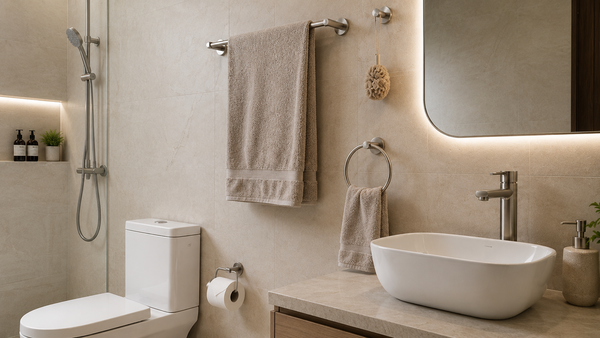
A water closet is the one fixture you can't skip in a bathroom. We tend to take it for granted, yet getting it right matters even more when every inch counts. In a typical small Malaysian bathroom — a condo unit, a terrace-house wash area, or a tight powder room — the wrong WC leaves you bumping the door or wedged against the basin.
The good news is that a small space doesn't limit your choices as much as you'd expect. With the right measurements and the right type, a comfortable, good-looking WC will fit into a surprisingly tight footprint. This guide walks through how to choose one, step by step.
The short video below is a useful primer on why your toilet choice matters before we get into the details.
Why Your Toilet Choice Matters More Than You Think
Source video: Top Homeowner on YouTube
1Why the right water closet matters more when space is tight
Quick Answer: In a small bathroom, the WC sets the whole layout. Its footprint, projection and clearance decide whether the door swings freely, whether you can reach the basin, and whether the room feels open or cramped. The wrong choice is an expensive mistake to undo later.
In a large bathroom you have slack to play with. In a small one, the WC is often the biggest fixed object in the room, so it quietly dictates where everything else goes. A bowl that sticks out too far blocks the door; a tank that sits too proud eats into the walkway; a seat at an awkward height makes a tight space feel tighter.
There's a bigger picture too. Billions of people worldwide still lack safely managed sanitation, so a clean, reliable WC is a basic comfort worth getting right rather than rushing. Spend a little time on the fit and the type now, and you avoid re-doing plumbing or returning a bowl that never suited the room.
2Start with the fit: rough-in size and trap setout
Quick Answer: Measure your setout first — the distance from the finished wall to the centre of the waste outlet. Malaysian homes mostly use an S-trap (outlet down to the floor) or a P-trap (outlet back into the wall). Common S-trap setouts are 200, 250 and 300 mm; P-trap is usually 180 mm. Match the WC to yours.
This is the step people skip, and it's the one that causes returns. Before you fall for a design, you need two facts about your existing plumbing: which way the waste outlet faces, and how far it sits from the wall.
- S-trap. The outlet drops vertically into the floor. This is the most common setup in older Malaysian homes and terrace houses.
- P-trap. The outlet runs horizontally into the wall. You'll see this more in newer condos and high-rise units, and it gives the shallowest footprint.
- Setout. Measure from the finished wall to the centre of the outlet (for an S-trap) or to the centre of the wall outlet (for a P-trap). That number decides which bowls will line up.
If you've seen the terms "10-inch" or "12-inch rough-in", those are the same idea in inches: 254 mm and 305 mm from the wall to the drain centre. A 10-inch model can help when the drain sits close to the wall in a tight bathroom. Get the setout wrong and the bowl simply won't seal over the outlet without extra parts or pipework.
| Outlet / setout | From wall (mm) | Typically suits |
|---|---|---|
| P-trap (wall outlet) | ~180 | Condos and new builds; shallowest footprint |
| S-trap, close | 200 | Very tight bathrooms; drain near the wall |
| S-trap, standard | 250 | Most existing Malaysian homes |
| S-trap, wide | 300 | Older houses with the drain set further out |
| 10-inch rough-in | 254 | Floor-outlet bathrooms needing a closer set |
| 12-inch rough-in | 305 | The default; widest model availability |
Standard sanitaryware setout references. Measure your own bathroom before buying.
Not sure which setout your bathroom has?
Bring your measurements in and we'll match the right bowl on the spot. Browse space-saving WC sets →
3One-piece, two-piece or wall-hung: which suits a small bathroom
Quick Answer: All three flush the same way; they differ in footprint, price and looks. Two-piece (close-coupled) sets cost the least. One-piece sets are seamless and easy to wipe down. Wall-hung sets hide the cistern in the wall and free up the most floor, but need an in-wall frame and professional fitting.
There are three main types of WC, and in a small bathroom the differences are more than cosmetic.
- Two-piece (close-coupled). The tank bolts onto the bowl. It's the most affordable and the easiest to carry and install, which is why it's the default in most homes. Browse close-coupled WC sets if budget is the priority.
- One-piece. Tank and bowl are moulded as a single unit. The seamless shape wipes clean in seconds and tends to sit a little lower and tighter, which suits a compact room. See the one-piece WC range.
- Wall-hung. The bowl mounts to a frame and the cistern hides inside the wall. It frees the most floor and looks the neatest, but it needs a concealed frame and a professional install. Compare these and other styles across our full WC collections.
For a tight bathroom, the honest trade-off is money versus space. A two-piece keeps costs down; a wall-hung buys you room and a cleaner look for a higher upfront spend.
| Type | Relative footprint | From (illustrative) | Install |
|---|---|---|---|
| Two-piece |
|
~RM 300 | Simplest, DIY-friendly |
| One-piece |
|
~RM 600 | Heavier; one unit |
| Wall-hung |
|
~RM 900 | In-wall frame; pro fit |
Illustrative footprint and entry pricing; actual specs and prices vary by model.
4How much space a wall-hung or compact WC really saves
Quick Answer: A wall-hung WC moves the cistern into the wall, trimming up to about 250 mm of projection and clearing the floor underneath. A compact one-piece saves less but still helps. In a tight bathroom, that reclaimed strip is often the difference between a door that swings freely and one that doesn't.
"Space-saving" sounds vague until you put numbers on it. The cistern is the bulky part of a standard WC, so hiding it in the wall is where the real gain comes from. The bowl also floats clear of the floor, which makes mopping easier and tricks the eye into reading the room as larger.
In a small bathroom, the strip of floor a wall-hung WC frees up is often what lets the door open without catching your knees.
| Setup | Floor depth used | Approx. (mm) |
|---|---|---|
| Standard two-piece |
|
~720 |
| Compact one-piece |
|
~660 |
| Wall-hung |
|
~500 |
Illustrative model based on typical fixture dimensions; floor under a wall-hung bowl stays clear.
5Measure before you buy: clearances for a small-bathroom WC
Quick Answer: Leave enough room around the WC: aim for at least 600 mm of clear space in front of the bowl, around 380 mm from the bowl's centre to any side wall or fixture, and a seat height of 390–420 mm. Always check the bowl won't block an inward-swinging door.
A WC that fits the plumbing can still feel wrong if it's crammed in. Clearance is what makes a small bathroom usable rather than just occupied. A quick trick before you commit: cut a cardboard template of the bowl's footprint, lay it on the floor, and open the door over it to see what really clears.
| Clearance | Recommended | Why it matters |
|---|---|---|
| Front of bowl to wall/door | ≥ 600 mm | Knee room and door swing |
| Bowl centre to side wall | ≥ 380 mm | Elbow room and easier cleaning |
| Seat height | 390–420 mm | Comfortable to sit and stand |
| Door swing | Clears the bowl | Avoids hitting knees or the seat |
General bathroom ergonomics guide; confirm against local plumbing requirements.
6Accessories, colours and finishes that earn their space

Quick Answer: A built-in bidet or washlet saves you fitting a separate hand bidet, which is handy when wall space is scarce. Dual-flush and rimless bowls keep things efficient and easy to clean. For colour, a white or light glossy finish bounces light and makes a small bathroom feel more open.
In a small bathroom, features that combine jobs are worth more than features that add fittings. A WC with a built-in bidet or washlet means you don't have to find wall space for a separate spray. A few small choices punch above their weight:
- Built-in bidet / washlet. One unit does two jobs, so you save the fittings and the wall space a separate bidet would need.
- Dual flush. A half/full button cuts water use, which adds up over a household's year.
- Rimless bowl. No hidden rim channel means fewer spots for grime and a faster wipe-down.
- Light, glossy finish. White or pale ceramic reflects light and helps a tight room read as bigger and cleaner.
Colour is the easiest way to make a small WC feel like it belongs. Matching the bowl to your basin and tiles keeps the eye moving smoothly instead of snagging on a mismatched fixture, which makes the whole room feel more considered.
7The bottom line
Quick Answer: Confirm your setout, pick the type that balances space and budget, check your clearances, then choose features and a finish that suit the room. Do those four things and a small bathroom stops being a constraint and starts feeling well-planned.
There's a lot to weigh when the room is small, and the range of water closets out there — different types, setouts and colours — can make the choice feel harder than it should be. You don't have to figure it all out alone. Our makeover consultants do this every day, and they're happy to talk it through.
Ready to find the perfect WC for your small bathroom?
Get the VIP treatment with a free one-on-one consultation at any Big Bath showroom. Our experts will match the right water closet to your space, setout and budget — no guesswork.
Book my free consultation →Want to stay in the loop? Subscribe to the Big Bath newsletter for first access to new launches, limited offers and events.
8Frequently Asked Questions
1. What's the difference between a 10-inch and 12-inch rough-in?
The rough-in is the distance from the finished wall to the centre of the floor drain — 254 mm for a 10-inch and 305 mm for a 12-inch. A 12-inch is the most common and gives you the widest model choice. A 10-inch helps when the drain sits closer to the wall, which is common in tight bathrooms.
2. Is a one-piece or two-piece WC better for a small bathroom?
Both work. A two-piece (close-coupled) set is cheaper and easier to install. A one-piece is seamless, easier to clean and often sits a little tighter, which suits a compact room. If budget is the deciding factor, go two-piece; if you want a neater, low-maintenance look, go one-piece.
3. Does a wall-hung WC really save space?
Yes. By hiding the cistern inside the wall, a wall-hung WC trims up to roughly 250 mm of projection and leaves the floor clear underneath. That open floor also makes a small bathroom look and feel larger, and it's far easier to mop around.
4. What's the cheapest space-saving WC option?
A compact one-piece or a close-coupled bowl with a shorter projection gives you most of the space benefit without the cost of an in-wall frame. Wall-hung saves the most room but carries a higher upfront and installation cost.
5. Can I add a bidet to a small-bathroom WC without extra space?
Choose a WC with a built-in bidet or washlet. Because the spray function is part of the bowl, you avoid fitting a separate hand bidet and the wall space it would need — a practical win when room is tight.